
Arbek Teknoloji
  1. Arbek
  2. Our Services
  3. Fuel Station Automation

Fuel Station Automation

Pump-tank-POS integration, EPDK-compliant data flow and real-time stock tracking; your station managed from a single point.

Fuel Station Automation

The measure of automation at a fuel station is whether the litre leaving the nozzle and the litre leaving the tank meet in the same data chain: nozzle-level sales records, millimetre-precision tank telemetry and fiscal register (ÖKC) integration come together in a single system. Arbek does not stop at installation: the station is connected to our own 24/7 monitoring centre in Ankara, catching pump faults and stock anomalies before they surface in a shift report. Having reverse-engineered and integrated undocumented hardware at protocol level, we also bring mixed-brand and legacy forecourts into scope.

We build and operate the full automation stack of a fuel station: pump control, tank gauging, shift reports and EPDK-compliant data flows, working with field-proven hardware and preserving your existing infrastructure.

We do not just install automation; we operate it 24/7 from our own monitoring centre. Even undocumented field hardware has been integrated through protocol-level reverse engineering, live in the field today.

01.

What this service covers

01
Pump automation

Every sale is recorded per nozzle in real time; a nozzle without automation authorisation dispenses no fuel, and unauthorised filling is locked out at the pump.

02
Central price distribution

Price changes are pushed from a single point to every pump and the cash register simultaneously; pump-versus-register mismatches caused by manual entry are eliminated.

03
Tank telemetry

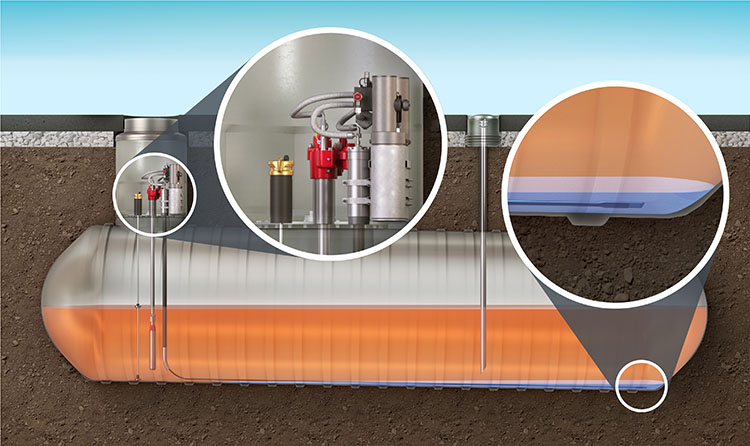
A millimetre-precision probe measures product level and water accumulating at the tank bottom separately; at critical levels an alarm is raised at the station and the monitoring centre at the same time.

04
Fiscal register (ÖKC) integration

Pump sales flow into the fiscal cash register automatically; the receipt, the automation record and the shift report all show the same litre.

05
Shift and stock reports

Dead stock, replenishment and loss reports are generated automatically at shift close; litres sold and litres drawn from the tank are compared in the same table.

06
EPDK 10338-compliant data flow

Sales and tank data is streamed to the distributor's automation system without interruption, in the scope and flow required by EPDK board decision 10338.

07
RFID vehicle identification

Fleet vehicles are identified by their tag during filling and the sale is posted directly to the vehicle; we have integrated readers with no manufacturer documentation by reverse-engineering their protocol.

08
24/7 remote monitoring

The station is connected to Arbek's own monitoring centre; pump faults, communication drops and alarms are tracked independently of the shift on duty.

02.

How we proceed

  1. 1 Site survey Pumps, tanks, probes and cash registers are inventoried down to brand and protocol; what can be kept from the existing hardware is settled here.
  2. 2 Integration plan Which unit connects over which protocol, the cabling and the cutover order are set out in a written plan; protocol analysis of undocumented hardware happens at this stage.
  3. 3 Installation and commissioning Work is planned one pump island at a time to minimise sales interruption; every nozzle and tank is verified individually as it is brought into the system.
  4. 4 End-to-end testing The chain is tested end to end, from nozzle sale to fiscal receipt and from tank draw-down to the EPDK data flow; deviations are removed by calibration.
  5. 5 24/7 operation The station is taken onto the monitoring centre; alarm tracking, remote intervention and, when needed, dispatching the Turkey-wide field team are part of continuous operation.
03.

Frequently Asked

Do our existing pumps and tank hardware have to be replaced?

In most cases, no; the automation is built on top of the existing hardware's protocols. Which units can be connected directly becomes clear during the survey; for undocumented hardware we carry out protocol analysis.

Does the station close for sales during installation?

The goal is for sales never to stop; work is planned island by island and around low-traffic hours. The exact cutover plan is drawn up after the survey, based on the station's layout and existing infrastructure.

Who is responsible for the EPDK data flow?

Producing and transmitting the data completely, without interruption and within the scope of decision 10338 is the automation side's job; ours; reconciliation with the distributor's system is verified jointly at commissioning. The legal side of reporting obligations depends on the station-distributor relationship.

What happens when there is a fault?

Because the station is connected to our 24/7 monitoring centre, the alarm usually reaches us before you call; cases that cannot be resolved remotely are routed to the Turkey-wide field team. The scope and priorities of intervention are defined in the operations contract.

Get a quote for Fuel Station Automation

Reach out for a survey and offer; we reply within 24 hours.

Get a Quote Ara